Boom Lift Working Height and Outreach: What Do You Actually Need?
Hire the wrong boom lift and you’ll find out on site — usually when the platform won’t quite reach, or the arm can’t clear the obstacle in the way. It’s a frustrating and costly mistake, and it’s entirely avoidable.
This boom lift working height guide explains working height, outreach, and ground conditions in plain English, so you can spec the right machine before it leaves our yard.
What Is Working Height — and Why It’s Not What You Think
When a boom lift is listed as a “15 metre machine”, that figure is the working height — not the height of the platform floor.
Working height assumes a 2 metre (6ft) operator standing upright on the platform with their arms raised. It’s the maximum height at which you can physically work. The platform floor itself sits roughly 2 metres lower.
So a “15m boom lift” puts your feet at around 13 metres.
This catches people out constantly. Always confirm both the working height and the platform height before you book. The advertised figure is nearly always the working height.
Working height vs platform height — quick reference:
| Term | What it means | Example: Genie Z45/25 |
|---|---|---|
| Working height | Max height you can work at (includes 2m for operator) | 15.72m (51.6ft) |
| Platform height | Actual height of the platform floor | 13.72m (45ft) |
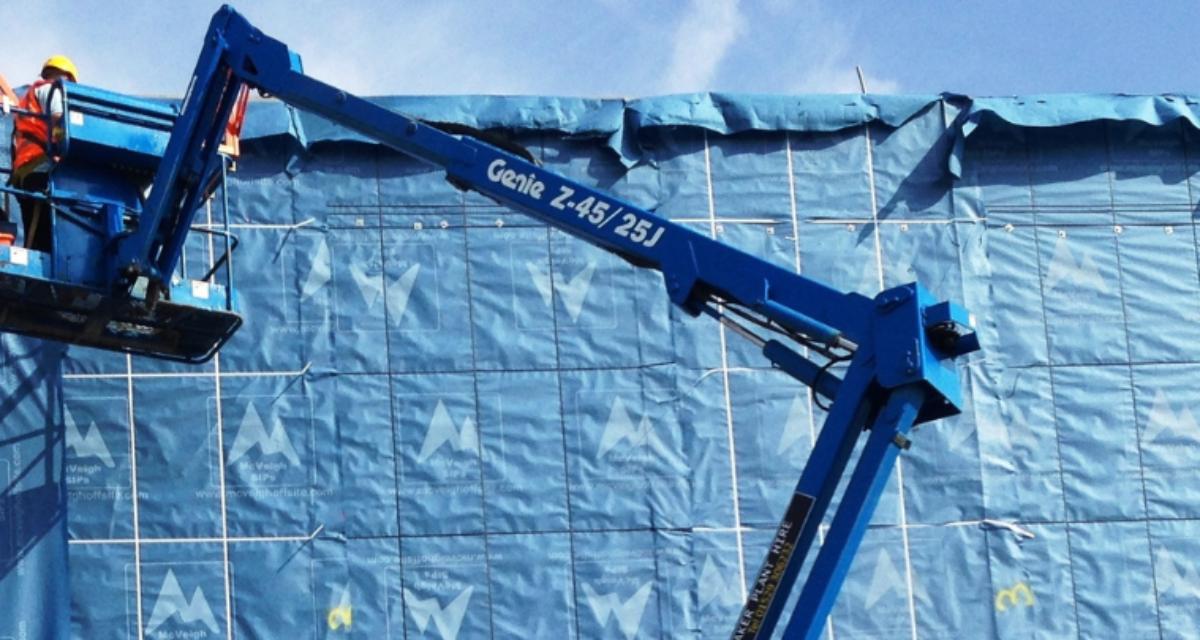
| Horizontal outreach | How far the arm extends horizontally | 7.47m (24.5ft) |
Outreach: The Number Most People Forget to Check
Height gets all the attention. Outreach is the figure that actually determines whether the machine can reach your work point.
Outreach is the horizontal distance the boom arm can extend from the base of the machine. If you can’t position the machine directly beneath the work point — because of a road, scaffolding, another piece of plant, or a building line — you need enough outreach to bridge the gap.
Here’s the issue: on most boom lifts, maximum height and maximum outreach cannot be achieved simultaneously. As the arm extends further horizontally, the maximum working height reduces. Your hire desk needs to know both your height requirement and your outreach requirement to spec the right machine — not just one or the other.
Rule of thumb: Always give us the height of the work point AND the distance from where you can safely park the machine. Those two numbers together determine everything.
How to Work Out What You Need (Five-Step Process)
No engineering knowledge required. Just work through these five questions before you call:
Step 1 — Where is the work point? The underside of a beam, the face of a cladding panel, a gutter at ridge height? Be specific.
Step 2 — How high is it? Measure or estimate the height from ground level to the work point. Add 2 metres. That’s your minimum working height.
Step 3 — Where can you position the machine? Is there anything stopping you parking directly below the work point? A road, a building line, services, scaffolding, other plant?
Step 4 — How far away will the machine be? Measure the horizontal distance from your planned machine position to the work point. That’s your minimum outreach.
Step 5 — Is there anything in the way? Any obstacle between the machine and the work point — a roofline, pipe run, overhead cable — will affect which arm type you need.
Give those five answers to our hire desk on 01529 306 232 and we’ll do the rest.
Articulating vs Telescopic: Which Arm Do You Need?
There are two main boom lift configurations. The difference matters more than most people realise.
Articulating (knuckle) boom lifts
The arm has multiple joints so it can bend and reach around obstacles. Use these when you need to work over or around something — a parapet, a roof edge, a structural frame — or when you can’t position the machine directly beneath the work point.
Common applications: cladding installation, fascia and soffit work, industrial maintenance, commercial fit-outs.
Telescopic (straight) boom lifts
The arm extends in a straight line. Use these when you have clear, open access and need maximum horizontal reach on large open sites.
Common applications: large-scale construction, steel frame erection, stadium and arena work, infrastructure projects.
Not sure which you need? If there’s any obstacle between the machine and the work point, default to articulating. When in doubt, describe the site to our hire desk and we’ll advise.
Common Job Types and the Heights They Typically Need
These are starting points — your specific site conditions will always be the deciding factor.
| Job type | Typical working height | Typical machine |
|---|---|---|
| Fascia/eaves on a two-storey building | 7–9m | 10m articulating boom |
| Industrial unit roof or gutters | 10–13m | 15m articulating boom |
| Commercial building cladding (3–4 storeys) | 13–17m | 17–20m articulating boom |
| Steel frame or structural work | 15–20m | 20m+ telescopic boom |
| Large-span roof, stadium or infrastructure | 20m+ | Z60 or equivalent |
Ground Conditions: Don’t Overlook This
A fully extended diesel boom concentrates significant weight on its outrigger pads. On soft, waterlogged, recently backfilled, or sloping ground, that concentration can exceed the ground’s bearing capacity — causing subsidence or, in the worst case, tip.
Before your machine arrives, ask yourself:
- Is the ground firm and level, or has it been recently disturbed?
- Are there any underground services, voids, or drainage runs beneath where the machine will sit?
- Is there a basement or cellar near the work area?
- Will the machine need to travel across soft ground to get into position?
If there’s any doubt, ground protection boards distribute the load. Ask us — we can advise and supply these alongside your hire.
All Baker Plant Hire diesel boom lifts are 4WD rough terrain machines built for UK site conditions. They’ll handle soft and uneven ground, but they’re not exempt from ground bearing considerations near excavations or recent groundworks.
Do I Need IPAF Training?
Yes. Under the Work at Height Regulations 2005 and HSE guidance on MEWPs, operators must be trained and competent. The recognised industry standard is IPAF (International Powered Access Federation) certification — specifically category 3b for boom-type MEWPs.
If your team needs certification, Baker Training runs IPAF courses from our Sleaford centre or on your site. Visit baker-training.co.uk for course dates, or call us and we’ll coordinate both the machine and the training from a single booking.
Frequently Asked Questions
What is the difference between working height and platform height? Working height assumes a 2m (6ft) operator standing on the platform. Platform height is the actual height of the platform floor. Working height is always approximately 2 metres more than platform height. The figure advertised by most manufacturers is working height.
Can I achieve maximum height and maximum outreach at the same time? Not usually. On most boom lifts, maximum height and maximum outreach are not achievable simultaneously — as the arm extends further out, the maximum height reduces. This is why you need to tell your hire desk both figures, not just one.
How do I know if I need an articulating or telescopic boom lift? If there are obstacles between your machine position and the work point, you need articulating. If you have clear, open access and need maximum horizontal reach, telescopic may be more suitable. Describe the site to our hire desk and we’ll advise.
What ground conditions are diesel boom lifts suitable for? Our diesel boom lifts are 4WD rough terrain machines built for uneven, soft, or muddy ground. However, you should always assess ground bearing capacity near excavations, voids, or recently backfilled areas. We can advise on ground protection if needed.
Can I bundle a boom lift with other equipment? Yes — and it saves money. Combine a boom lift with scissor lifts, telehandlers, forklifts or other plant into one order and you pay a single consolidated delivery charge rather than separate delivery fees to multiple suppliers.
Ready to Book?
Tell us your working height, outreach, and site conditions and we’ll match the right machine from our fleet.
Call 01529 306 232 or get in touch via the enquiry form at bakerplanthire.co.uk
BPH | Baker Plant Hire is a registered company in England.
© BPH | Baker Plant Hire 2026. All Rights Reserved